
Workshop for Fostering Team Trust and Gamifying Project Collaboration
Is your team collaboration at risk of damaging profit margins? Are roles and responsibilities misunderstood? This workshop is for you if you are struggling with implementing a defined process.

In this case study, I share my approach to a recent workshop. You can use this workshop to build a common language and lay the foundation for open discussions on how to work together.
Ultimately, the goal of facilitating this process is to build a confident and communicative organization that work together efficiently across: disciplines, organizational structure and time zones.
Background
A recent merger had created uncertainty around how employees should be collaborating. Employees from three companies were taking on new roles and new levels of responsibility in a larger company, and having to level up in their responsibility. We were tasked with helping everyone understand what their role is now, and what it isn't, and how they can work together going forward.
When multiple companies merge, employees often struggle with new roles, responsibilities, and work processes. Without a clear integration strategy, silos form, hindering efficiency and communication. In our two-and-a-half-hour workshop for 30 participants, we tackled this head-on using a structured and interactive workshop.
Structured Facilitation Techniques Engage Participants for Embodied Learning
Below I outline the structure of the workshop that was facilitated in Houston at the end of January. This workshop was set up in a room of 6 tables with 5-6 participants per table. I let people sit wherever they like at the start. We will mix them up intentionally later.
Introductions
It’s always a good idea to introduce yourself when you are facing a room of people - even if you know them. In this case I knew a few faces and some were new. I was able to shake hands with some of those new faces I had spoken to in a pre-workshop call as they entered the room. Then bringing the room to listening mode, I spoke a bit about who I am and why I was there. Giving a bit of a personal motivation shows my vulnerability and sets the scene for an open dialogue.
My co-facilitator, the expert in the room, gave an introduction on why the top management had chosen the Project Framework and the benefits it presents.
Step 1: Establishing Role Clarity
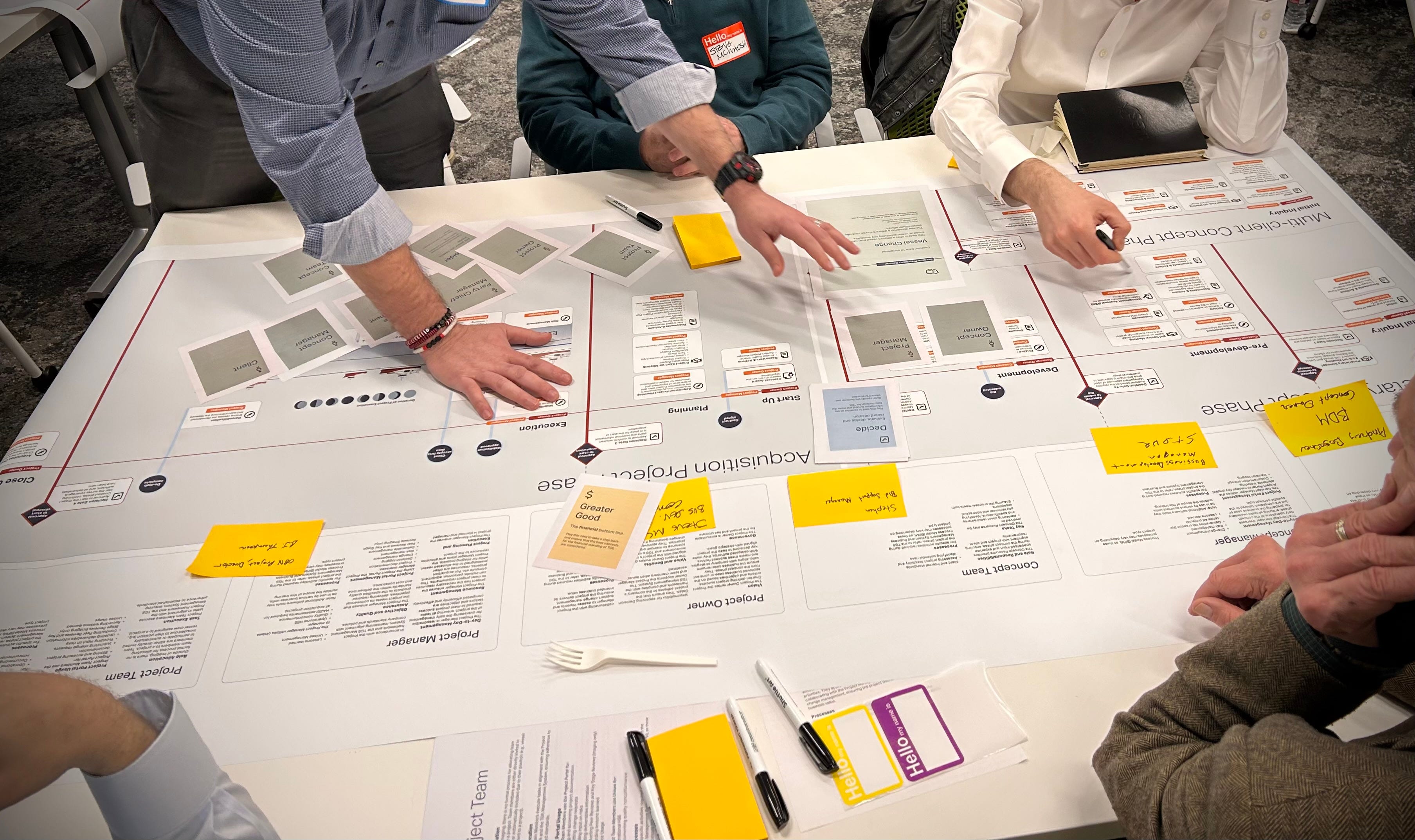
We introduced the roles associated with our Project Framework - a process developed by the Quality Department outlining key roles, stage gates and steps necessary for seamless project execution. The roles were printed out on individual pieces of paper and copies distributed to every table in the workshop.
Give participants plenty of time to read through, understand and select a role they identify with. Then altogether, ask them to go and stand in the corner of the room that has that role on the wall. Everyone stood in their discipline family groups. They looked around at the visually mapped functions within the organization.
Step 2: The Power of Perspective
Inspired by Annette Simmons, we ran a powerful exercise: each group voiced the negative stereotypes others held about them. Then, the rest of the room shared the positive attributes of that same role.
This exercise fosters a mindset shift, encouraging empathy and understanding across teams. We reinforced this with the Faces/Vases Paradox, illustrating the importance of perspective in team collaboration. We can’t see both at once, we are reminded that in order to be able to understand someone else’s perspective we must first stop looking at things the way we’ve always looked at them.
Step 3: Creating Mixed Teams
To create a cross-functional collaboration for the rest of the workshop, we mixed participants into diverse teams, ensuring each table had representatives from different roles. This setup created the perfect environment for the next phase: scenario-based problem-solving.
Step 4: Introducing the Project Framework
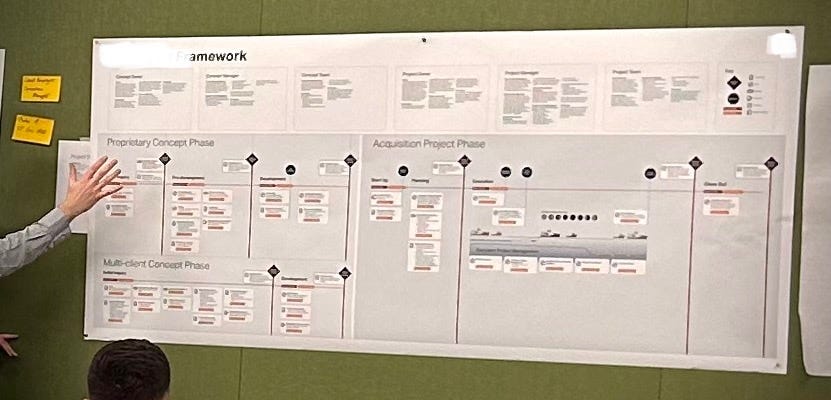
Everyone sat down with their newly formed, mixed teams. My co-facilitator, the expert in the room, introduced the Project Framework—a visual representation of project roles and responsibilities. He talked through the phases and decision gates and what was happening across the process. This took around 10 minutes.
Each table received a large Project Framework Poster to use as a reference throughout the workshop.
Step 5: The Scenario Game
Traditional training often falls flat in complex B2B environments. To ensure real engagement, we used scenario-based learning to help participants navigate project challenges within the Project Framework.
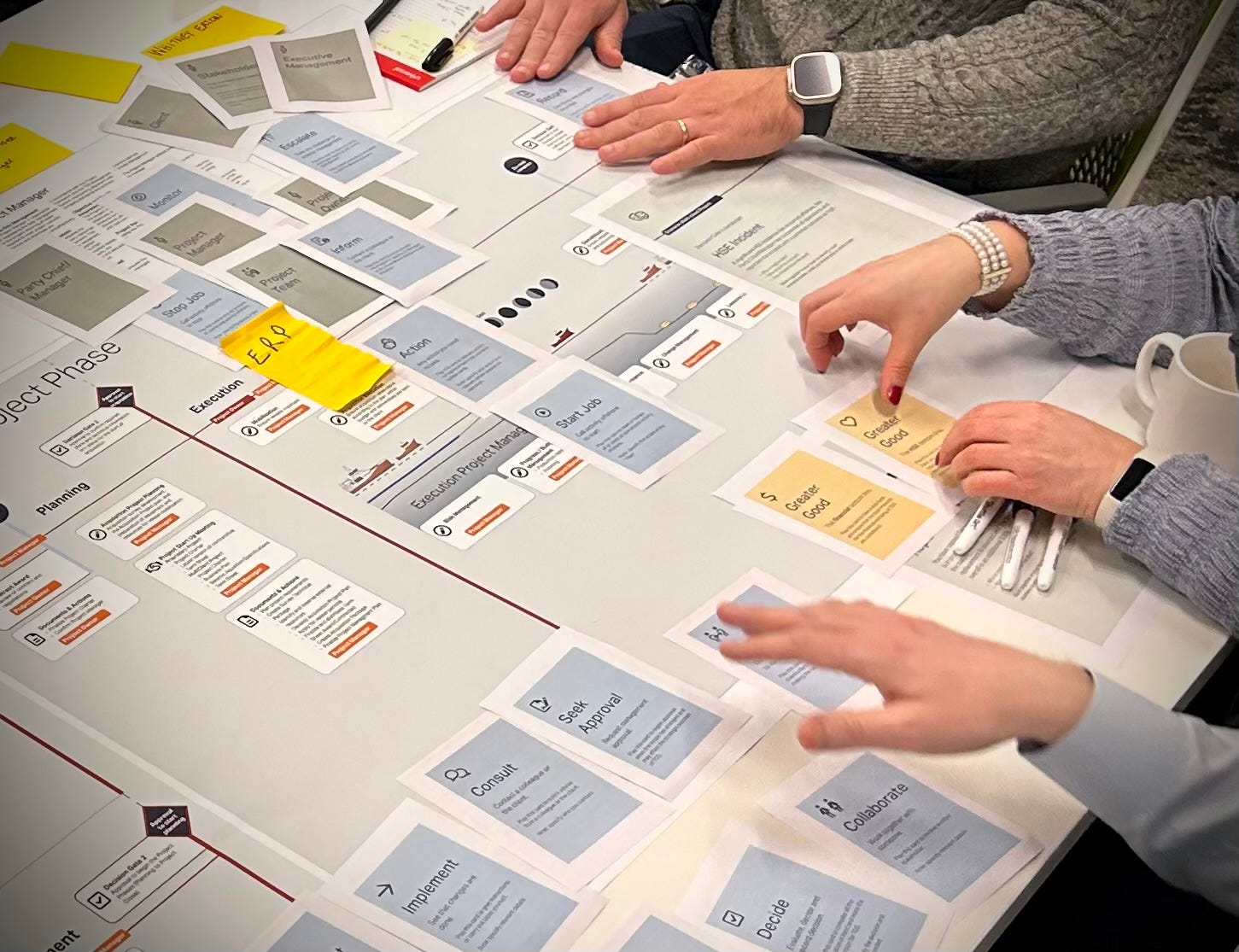
Each scenario represented a real-world deviation from the standard project process. We indicated on the scenario where in the Framework this is happening and asked some standard questions:
Who is responsible?
Who needs to be involved?
How would you handle this situation?
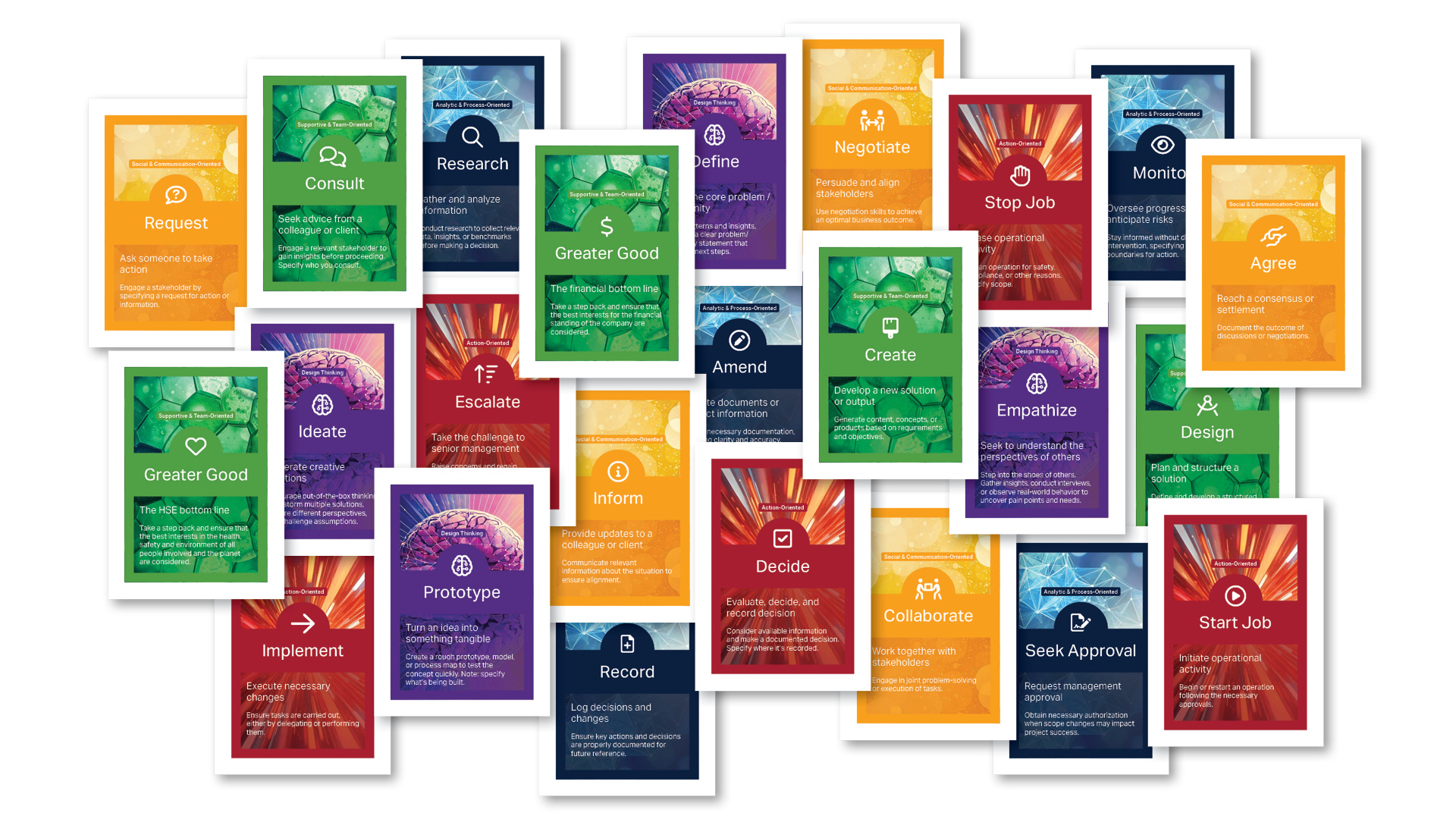
Teams were given Scenario Builder Cards, which provide an assisted role play function, a tool to guide discussions.
This gamified problem-solving approach allowed participants to practice decision-making in a safe environment, leading to deeper learning and engagement.
Step 6: Facilitating Reflection & Knowledge Transfer
After discussing solutions for each scenario, we invited one team to present their approach, and a second team to share an alternative. My co-facilitator was able to provide guidance on the intended solution and what considerations might have caused deviation. These reflection moments drove the real learning—encouraging teams to refine their thought processes and improve decision-making.
Closing
We wrapped up with an invitation for a couple of reflections from each participant. I noted these down on the flip chart. We saw a real desire for more scenarios and comments that others in the organization should have the same training.
Top Tip
Use structured role-identification exercises to clarify job functions and responsibilities in your organization. This ensures employees understand their contribution to the bigger picture.